Spatterdock / Cow Lily
Identification
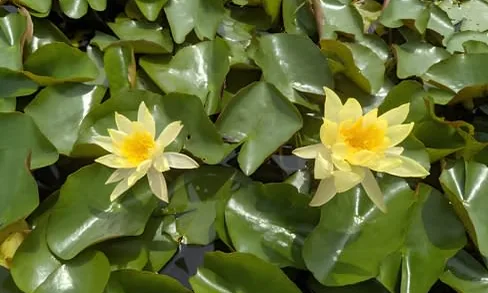
Spatterdock is an emergent aquatic plant with heart shaped leaves. Those leaves often float, but they can also emerge from the water - standing up to 2 feet above the surface. That standing habit is distinctive; true water lilies lie flat.
The flowers are yellow and 1 to 2 inches in diameter, blooming in July and August. Below the surface, a network of rhizomes connects to long stems. Growth typically occurs in 1 to 2 feet of water.
Telling Spatterdock from Water Lilies
Spatterdock is confused with water lilies routinely. The flower is the fastest check: spatterdock's yellow flowers are much smaller than lilies, at 1 to 2 inches in diameter. The leaf habit helps too - spatterdock leaves frequently stand above the water rather than resting on it.
Why It Matters
Spatterdock is worth thinking about carefully before treating. It is an excellent source of cover and habitat for fish, and it provides food for aquatic life as well as for animals outside the pond.
Management, rather than removal, is usually the right frame for a plant doing this much work in a waterbody.
Control Approach
Early season, from the bottom. Navigate is granular and the granules sink to the bottom, which suits a rhizome-based plant. It is used for early season control.
Later, from the top. Clearcast is sprayed on mature vegetation at the water surface, with results noticed in 7 to 10 days. It can be mixed with Pondzilla treatment enhancer.
Which one you reach for is mostly a question of timing: whether you are ahead of the growth or dealing with mature pads and flowers.
Recommended Treatment Products
These are the products Natural Waterscapes recommends for spatterdock / cow lily, with the role each one plays. Read the label and confirm the product suits your waterbody before applying.
Common Questions
How do I tell spatterdock from a water lily?
Spatterdock's yellow flowers are much smaller than water lily flowers, at 1 to 2 inches in diameter. Spatterdock leaves are heart shaped and often stand above the water surface rather than floating flat.
When does spatterdock flower?
The yellow flowers bloom in July and August.
How deep does spatterdock grow?
Growth typically occurs in 1 to 2 feet of water.
Is spatterdock good for a pond?
It is an excellent source of cover and habitat for fish, and provides food for aquatic life and for animals outside the pond.
Need help with spatterdock / cow lily?
Our pond and lake experts can confirm the identification and recommend a treatment plan sized to your waterbody. Send a photo or give us a call.