Parrot Feather
Identification
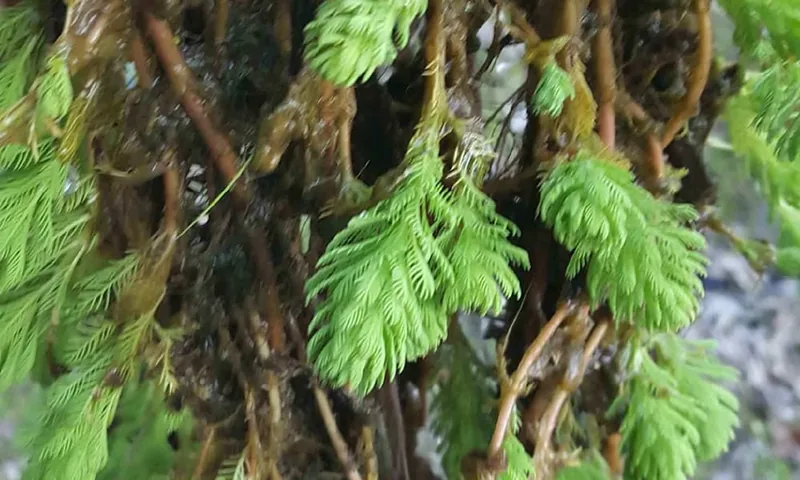
Parrot feather gets its name from the feathery bright green leaves that grow from the stems. The stems branch and run brownish red to green.
The defining behavior is vertical. Although this is a submerged plant, parts of it grow up to 12 inches out of the water. If you are looking at feathery milfoil-like foliage standing above the surface, you are almost certainly looking at parrot feather.
It is a rooted aquatic plant found in lakes, ponds, and streams throughout the United States, though it is not a native species.
Telling Parrot Feather from Eurasian Watermilfoil
These two are often misidentified as one another, and they are members of the same plant family, so the resemblance is real. The separation is simple and reliable: Eurasian watermilfoil grows only below the water surface, whereas parrot feather produces emergent stems. Look at the surface, not the leaves.
Why It Matters
Dense mats that form at the surface outcompete desirable aquatic plants. Growth also reduces recreational usage and clogs drains and streams.
There is a public health angle as well: parrot feather creates an ideal habitat for mosquito larvae to hatch, increasing mosquito populations around the water.
Control Approach
Because parrot feather breaks the surface, treatments that reach emergent foliage matter here in a way they do not for fully submerged weeds.
Mixing. Harvester is mixed at 1 quart Harvester to 1 gallon Cutrine to improve results.
After treatment. Apply pond dye to reduce sunlight, monthly for best results, and use Muck Remover pellets to break down decaying parrotfeather and other muck in the pond.
Recommended Treatment Products
These are the products Natural Waterscapes recommends for parrot feather, with the role each one plays. Read the label and confirm the product suits your waterbody before applying.
Common Questions
How do I tell parrot feather from Eurasian watermilfoil?
Eurasian watermilfoil grows only below the water surface. Parrot feather produces emergent stems that grow up to 12 inches out of the water.
Is parrot feather native?
No. Although it is found throughout the United States, it is not a native plant species.
Does parrot feather attract mosquitoes?
It creates an ideal habitat for mosquito larvae to hatch and increases mosquito populations.
What is the mix rate for Harvester and Cutrine?
1 quart Harvester to 1 gallon Cutrine.
Need help with parrot feather?
Our pond and lake experts can confirm the identification and recommend a treatment plan sized to your waterbody. Send a photo or give us a call.