
Watermilfoil
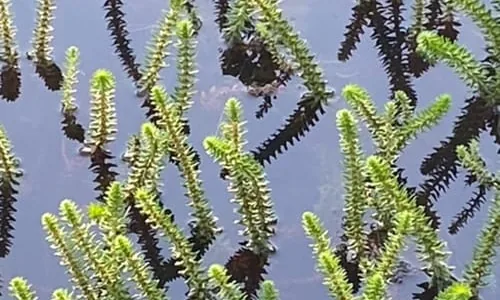
Identification
Milfoil reads as feathery underwater, and the count is what separates it from its look-alikes. Leaves grow in whorls of 4 around the stem, and each leaf carries 12 or more leaflet pairs - that leaflet number is the diagnostic detail worth learning.
Stems are green and reach up to 8 feet, with the color shifting to reddish brown closer to the tip. It is a rooted, submerged plant that grows in 1 to 15 feet of water, and deeper in water clear enough to pass light.
Look-Alikes
Parrot feather is the easiest to rule out: it emerges up to a foot above the water surface, while Eurasian watermilfoil stays below it. Coontail and bladderwort both read similar underwater and are regularly confused with milfoil.
Two native relatives matter too. Northern watermilfoil has fewer leaflet pairs, is native, and is less of a threat. Variable leaf milfoil is also separated by leaflet count. Counting leaflet pairs before you treat is worth the minute it takes.
Why It Matters
Milfoil forms dense mats that block sunlight from reaching the water below. Heavy infestations can result in decreased dissolved oxygen levels, and the plant chokes out native species that would otherwise hold that space. Boating and angling both suffer once mats establish.
Because it spreads mainly through fragmentation, and because boat traffic is a primary cause of that fragmentation, milfoil tends to expand fastest in exactly the water people use most.
Control Approach
Mechanical. Raking works, but every broken stem must come out - fragments left behind root and regrow. Grass carp cannot be used to manage watermilfoil. That rules out the biological option people usually ask about first.
Barrier. LakeMats along docks and shorelines hold specific areas clear.
Chemical. Systemic products go after the roots slowly; contact products work fast on what they touch.
After treatment. Apply pond dye monthly to reduce sunlight, and use Muck Remover pellets to break down decaying milfoil.
Recommended Treatment Products
These are the products Natural Waterscapes recommends for watermilfoil, with the role each one plays. Read the label and confirm the product suits your waterbody before applying.
Common Questions
Will grass carp eat watermilfoil?
No. Grass carp cannot be used to manage watermilfoil.
How do I tell watermilfoil from parrot feather?
Parrot feather emerges up to a foot above the water surface. Eurasian watermilfoil grows only below the surface.
How is watermilfoil spread?
Mainly through fragmentation. Broken stems produce new roots, and breakage is often caused by boat motors and boat wake.
How long does Sonar take on milfoil?
Sonar takes 30 to 60 days for complete control. The slow kill is what protects fish.
Need help with watermilfoil?
Our pond and lake experts can confirm the identification and recommend a treatment plan sized to your waterbody. Send a photo or give us a call.