Coontail / Hornwort
Identification
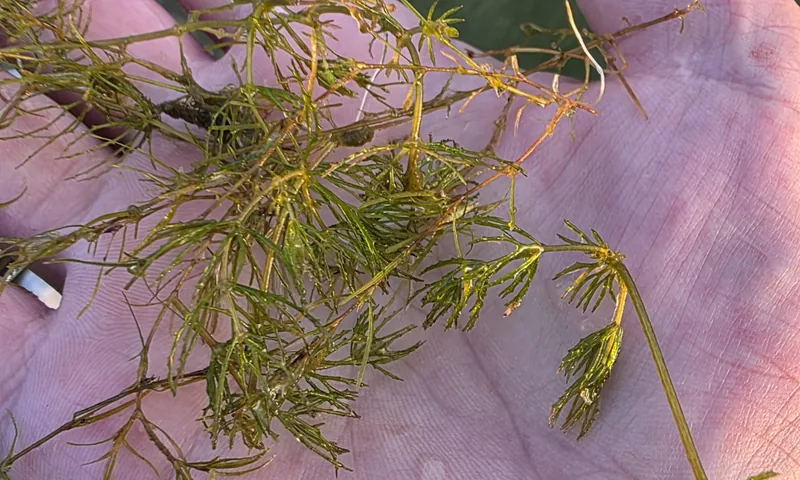
Coontail feels different from the other submerged weeds, and touch is the fastest identification. The leaves are stiff and spiny - green, needle-like, arranged in whorls around the stem, and carrying small teeth or bumps. Milfoil and fanwort feel soft; coontail does not.
The second tell is underground, or rather the absence of it. Coontail is a non-rooted, free floating plant. Pull a clump and there is nothing anchoring it. Stems run up to 11 feet, and it grows in water deeper than 6 feet. Flowers and fruit form at the base of the leaf and do not grow above the water surface.
Look-Alikes
Watermilfoil has more feather-like leaves and is more delicate - the stiffness test separates them quickly. Fanwort forms fan-shaped leaves opposite one another on the stem rather than whorled around it, and fanwort stems are often red. Chara is also confused with coontail.
Why It Matters
Coontail earns its place in a pond. It provides fish habitat, produces oxygen, and takes up nutrients. It also releases a chemical that inhibits the growth of other weeds and can stop the growth of harmful phytoplankton - which means a moderate coontail population is doing work you would otherwise pay for.
The problem is volume. Coontail can take over a pond if left unmanaged, and rapid growth is a symptom: it occurs when there are excess nutrients, specifically nitrate and phosphate. Runaway coontail is usually telling you something about the nutrient load.
Control Approach
Mechanical. Rakes work, but coontail reproduces through fragmentation, so remove all vegetation rather than most of it.
Biological. Grass carp will eat coontail.
Chemical. Because coontail is not rooted, treatments that work through the root system are the wrong tool. Contact and whole-pond options are the usual choices.
After treatment. Apply pond dye monthly to reduce sunlight, and use Muck Remover pellets to break down decaying coontail.
Recommended Treatment Products
These are the products Natural Waterscapes recommends for coontail / hornwort, with the role each one plays. Read the label and confirm the product suits your waterbody before applying.
Common Questions
Is coontail bad for a pond?
Not inherently. Coontail provides fish habitat, oxygen production, and nutrient uptake, and it releases a chemical that inhibits other weeds and can stop harmful phytoplankton. It becomes a problem when it takes over.
Does coontail have roots?
No. Coontail is a non-rooted, free floating plant, which is one of the fastest ways to tell it apart from other submerged weeds.
How do I tell coontail from milfoil?
Coontail leaves are stiff and spiny. Milfoil has more feather-like leaves and is more delicate.
Why is my coontail growing so fast?
Rapid growth occurs when there are excess nutrients in the water, specifically nitrate and phosphate.
Need help with coontail / hornwort?
Our pond and lake experts can confirm the identification and recommend a treatment plan sized to your waterbody. Send a photo or give us a call.