
Fanwort / Cabomba
Identification
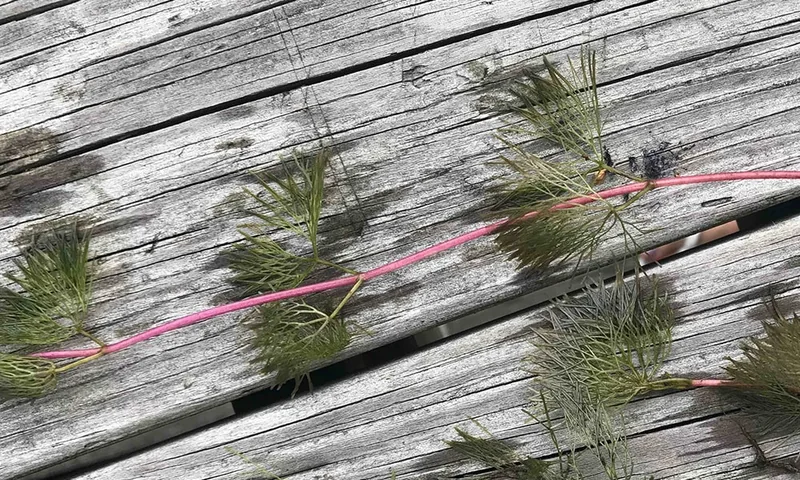
The name does the work: fanwort leaves are fan shaped, and they branch opposite one another along the stems rather than whorling around them. Leaves run green to dark green and sometimes reddish brown. The stems are red and reach 10 to 30 feet.
Most of the plant stays submerged, but the flowers come to the surface - small white petals with a yellow center, much like a daisy. Fanwort grows in water up to 10 feet deep.
Look-Alikes
Fanwort gets confused with watermilfoil and coontail because all three read as bushy underwater. The key distinction is arrangement: fanwort leaves do not whorl around the stem, they form opposite each other instead. Milfoil and coontail both whorl. Check one node and you have your answer.
Why It Matters
Fanwort is classified as an invasive plant species in many states and outcompetes desired aquatic plants.
Timing makes it worse. In late summer the stems become fragile and break easily, and free floating fragments can survive for up to 8 weeks. That is a long window for a fragment to drift, settle, and start a new colony - which is why late-season mechanical work on fanwort tends to backfire.
Control Approach
Chemical. Sonar provides the best long term fanwort control, and there are faster contact options when you need a quicker result.
Mixing. Harvester is mixed at a rate of 1 quart Harvester to 1 gallon Cutrine.
After treatment. Apply pond dye to reduce sunlight from reaching the bottom of the pond where new growth begins, and use Muck Remover pellets to break down decaying fanwort.
Recommended Treatment Products
These are the products Natural Waterscapes recommends for fanwort / cabomba, with the role each one plays. Read the label and confirm the product suits your waterbody before applying.
Common Questions
How do I tell fanwort from milfoil and coontail?
Fanwort leaves form opposite each other on the stem. Milfoil and coontail leaves whorl around the stem. Fanwort stems are also often red.
How long do fanwort fragments survive?
Free floating fragments can survive for up to 8 weeks.
When is fanwort most likely to spread?
In late summer, when the stems become fragile and break easily.
What is the mix rate for Harvester and Cutrine on fanwort?
1 quart Harvester to 1 gallon Cutrine.
Need help with fanwort / cabomba?
Our pond and lake experts can confirm the identification and recommend a treatment plan sized to your waterbody. Send a photo or give us a call.