Bladderwort
Identification
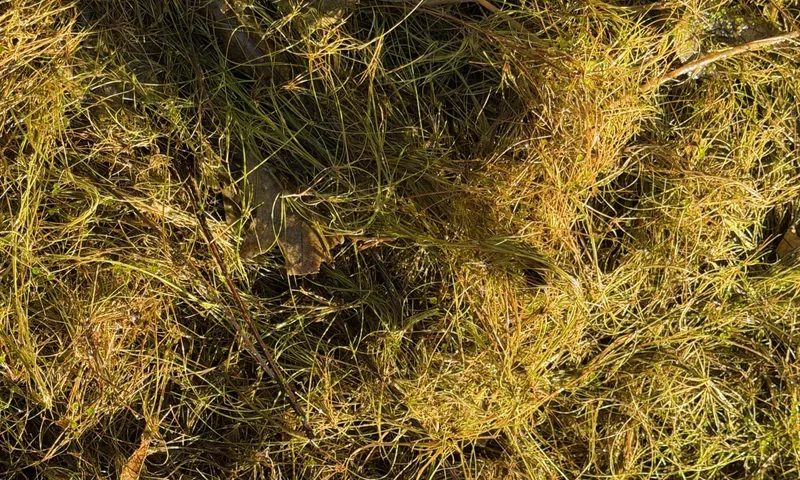
Bladderwort gets its name from the small bladder-like slimy balls attached to the leaves. Those are the identification, and they are also the point of the plant. The traps range in size from 0.2mm to 1.2cm, and the stem of a bladderwort can be covered by hundreds of them.
From the stems, tiny green to brown leaves form in a net-like pattern. It also produces small yellow or lavender flowers that emerge above the water. Unlike many other pond weeds, bladderwort is free floating - there is no root system anchoring the stems in place. It is typically found in calm water.
A Carnivorous Plant
Bladderwort is a carnivorous plant, and this is not a curiosity - it changes how the plant behaves. Most aquatic plants take up nutrients for food through their roots. Bladderwort consumes food by capturing aquatic organisms, including mosquito larvae.
That has a practical implication for control: bladderwort is not drawing its living from the sediment, so approaches built around root uptake do not apply to it.
Why It Matters
Dense bladderwort growth creates intricate mats with real consequences for water circulation. Those mats limit the movement of water, potentially disrupting natural flow patterns and hindering the exchange of nutrients and oxygen. It can outcompete native vegetation, leading to reduced biodiversity.
There is also an odor problem. Heavy growth can contribute to the development of unpleasant odors, because dense mats create an ideal breeding ground for bacteria and decomposition processes.
Management is complicated by the fact that bladderwort propagates through both seeds and fragmentation, and spreads easily because nothing anchors it in place.
Control Approach
Mechanical. Bladderwort can be removed with rakes. Because it reproduces through fragmentation, remove all vegetation. The upside: bladderwort has no root system, so once it is removed you do not have to worry about regrowth from roots left behind.
Biological. Grass carp can also be used to control bladderwort.
Important: granular herbicides are not recommended, because bladderwort is not a rooted weed. Granules sink to the bottom, which is not where this plant lives.
Recommended Treatment Products
These are the products Natural Waterscapes recommends for bladderwort, with the role each one plays. Read the label and confirm the product suits your waterbody before applying.
Common Questions
Is bladderwort really carnivorous?
Yes. Bladderwort captures small prey, including mosquito larvae, using bladder-like traps. Most aquatic plants take up nutrients through their roots; bladderwort consumes food by capturing aquatic organisms.
Why are granular herbicides not recommended for bladderwort?
Granular herbicides are not recommended because bladderwort is not a rooted weed.
Will bladderwort grow back from roots after raking?
No. Bladderwort has no root system, so once removed you do not have to worry about regrowth from roots left behind. You do need to remove all vegetation, since it reproduces by fragmentation.
Does bladderwort cause pond odor?
Dense growth can contribute to unpleasant odors, because the mats create an ideal breeding ground for bacteria and decomposition processes.
Need help with bladderwort?
Our pond and lake experts can confirm the identification and recommend a treatment plan sized to your waterbody. Send a photo or give us a call.