Phragmites / Common Reed
Identification
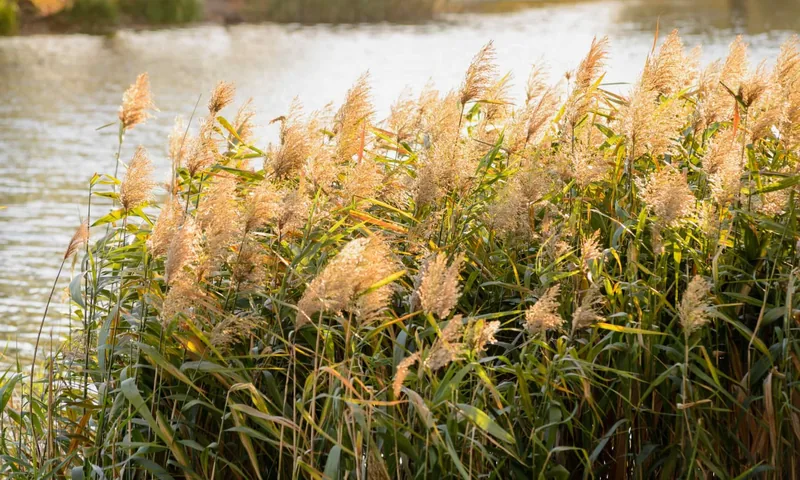
Phragmites is the tallest thing on most shorelines: green grass-like leaves on stalks running 6 to 20 feet tall, topped with a feathery tassel similar to the top of a corn stalk.
The part you cannot see matters most. Phragmites rhizomes grow down 6 feet into soil, which is why surface-level control fails so reliably against it.
It can grow in 2 feet of water depth.
Native vs. Invasive
There are two reeds here and they are not the same problem. Phragmites australis is the non-native invasive form. Phragmites americanus is native and non-invasive.
Growth habit separates them in the field: the invasive form builds dense stands, while the native species typically grows amongst other vegetation. A solid monoculture wall of reed is the invasive one. Reed mixed in with other shoreline plants usually is not.
Why It Matters
Invasive phragmites reduces habitat for fish and wildlife, and blocks out and outcompetes desired plant species. Its extreme height causes visibility issues around the water.
It also produces more waste than shorter shoreline weeds - and notably, 80 percent of the total organic waste is actually below the surface. The muck load from a phragmites stand is largely invisible.
Reproduction is prolific: roughly 2,000 seeds per plant per season, dispersed primarily by wind, on top of the rhizome network.
Control Approach
Timing is the whole game. Treat when the weed is in full bloom, with the seed plume present.
Do not cut too soon. Do not remove vegetation until at least 2 weeks after herbicide application. Cutting early stops the herbicide from reaching those 6-foot rhizomes, and you will be back to the same stand next season.
Non-chemical. Mechanical clearing or prescribed fire.
Recommended Treatment Products
These are the products Natural Waterscapes recommends for phragmites / common reed, with the role each one plays. Read the label and confirm the product suits your waterbody before applying.
Common Questions
How do I tell invasive phragmites from the native reed?
Invasive Phragmites australis forms dense stands. The native Phragmites americanus typically grows amongst other vegetation rather than in a monoculture.
When should phragmites be treated?
When the weed is in full bloom and the seed plume is present.
Can I cut phragmites right after spraying?
No. Do not remove vegetation until at least 2 weeks after herbicide application.
How deep do phragmites rhizomes go?
Rhizomes can grow down 6 feet into soil.
Need help with phragmites / common reed?
Our pond and lake experts can confirm the identification and recommend a treatment plan sized to your waterbody. Send a photo or give us a call.